
Writing & research

Publications

Papers, technical notes, and practical articles from things I study and build.
Paper20264 min read

Binary Classification for Next-Day Gold Price Movements Using Machine Learning

This study explores next-day gold price direction prediction using supervised machine learning. Daily Indonesian gold price data are transformed into features such as log returns, moving-average ratios, and short-term volatility, then classified using Naïve Bayes, Logistic Regression, and Support Vector Machine. Among the evaluated models, Logistic Regression achieved the strongest overall performance, with an F1-score of 0.737 and accuracy of 58.3%, showing the potential of engineered financial features for short-term directional forecasting.

Gold pricemachine learningprice direction classification+3
Read publication
Paper20254 min read

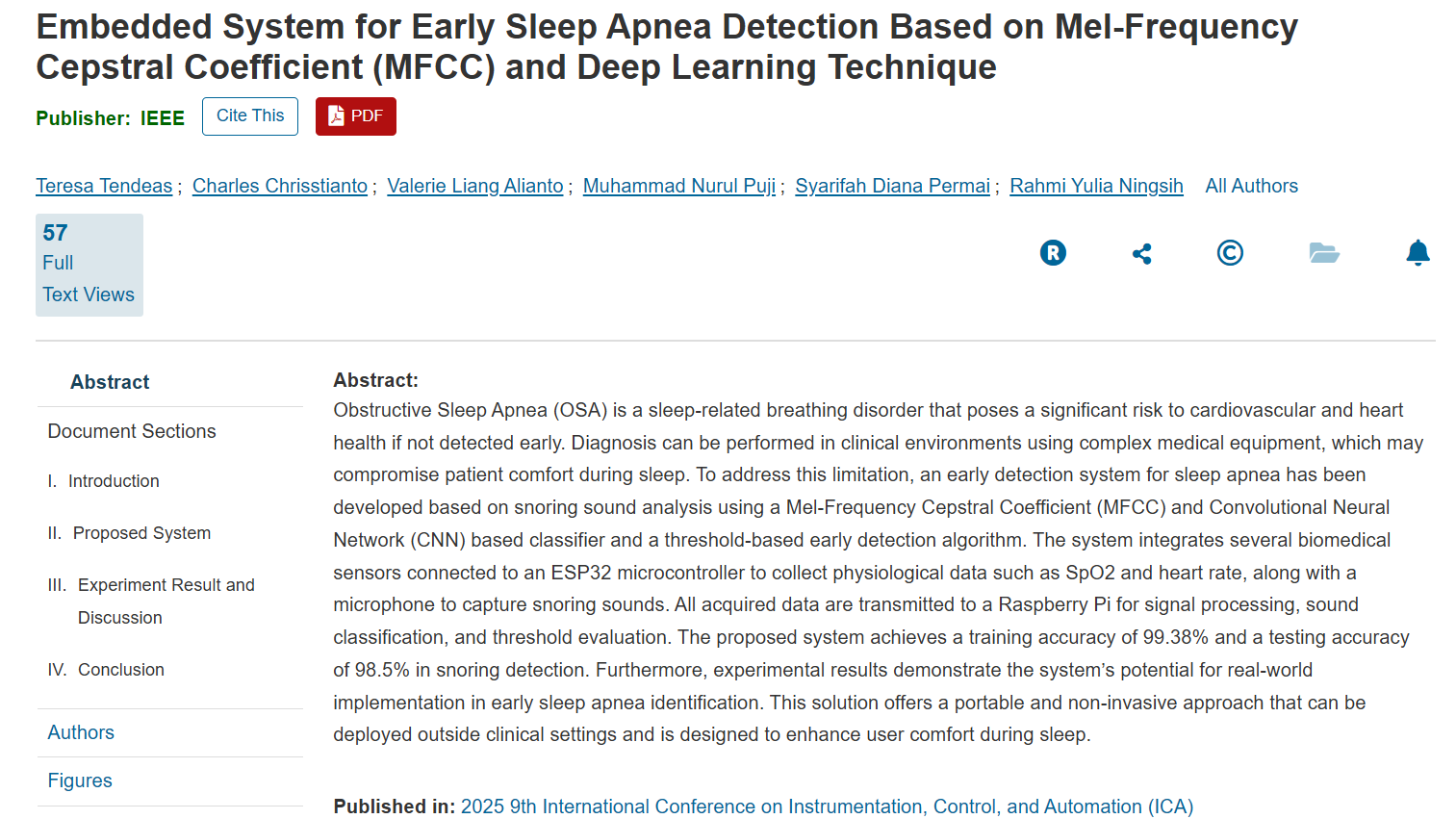
Embedded System for Early Sleep Apnea Detection Based on Mel-Frequency Cepstral Coefficient (MFCC) and Deep Learning Technique

This research presents an embedded system for early sleep apnea screening by combining physiological monitoring with audio-based snoring detection. The system uses MFCC feature extraction and a Convolutional Neural Network (CNN) to classify snoring sounds, while sensors connected to an ESP32 and Raspberry Pi monitor parameters such as SpO₂, heart rate, respiratory activity, and body movement. The optimized CNN achieved 99.38% training accuracy and 98.50% testing accuracy, demonstrating the system’s potential as a portable, non-invasive solution for preliminary sleep apnea monitoring outside clinical environments.

sleep apneaconvolutional neural network (CNN)snoring+2
Read publication
Paper20254 min read

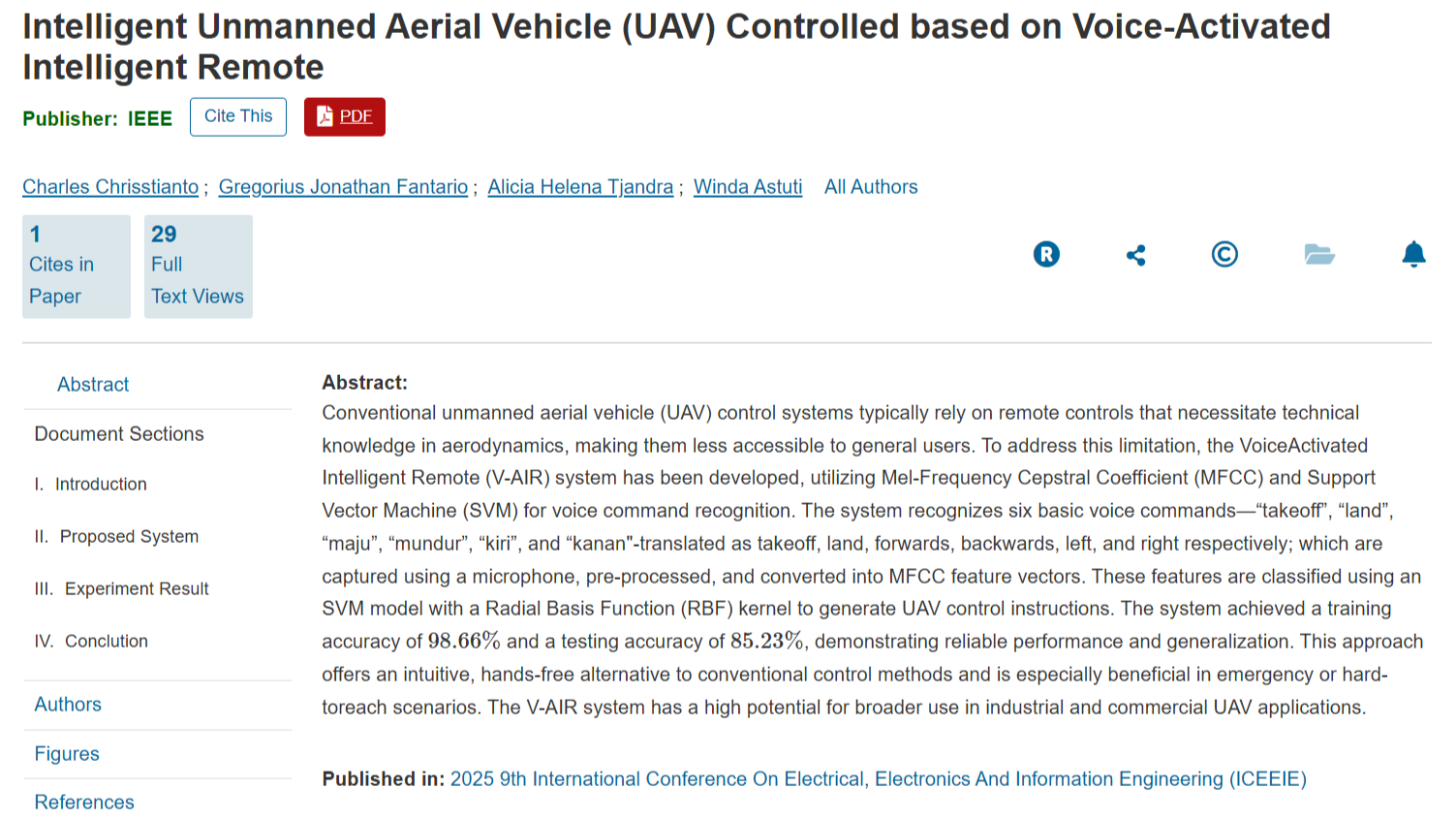
Intelligent Unmanned Aerial Vehicle (UAV) Controlled based on Voice-Activated Intelligent Remote

V-AIR (Voice-Activated Intelligent Remote) is a voice-based UAV control system designed to make drone operation more intuitive and accessible. The system uses Mel-Frequency Cepstral Coefficients (MFCC) for speech feature extraction and an SVM with an RBF kernel to recognize six basic flight commands: takeoff, land, forward, backward, left, and right. The developed model achieved 98.66% training accuracy and 85.23% testing accuracy, demonstrating the potential of voice commands as a practical hands-free alternative to conventional UAV controllers.

Mel Frequency Cepstral Coefficient (MFCC)Support Vector Machine (SVM)Unmanned Aerial Vehicles (UAVs)+2
Read publication